



Edmonton Infill: What Eight-Plexes Mean for Your Home and Your Mortgage
By Daniel De Sousa · Published October 13, 2026 · Permit data current to October 13, 2026
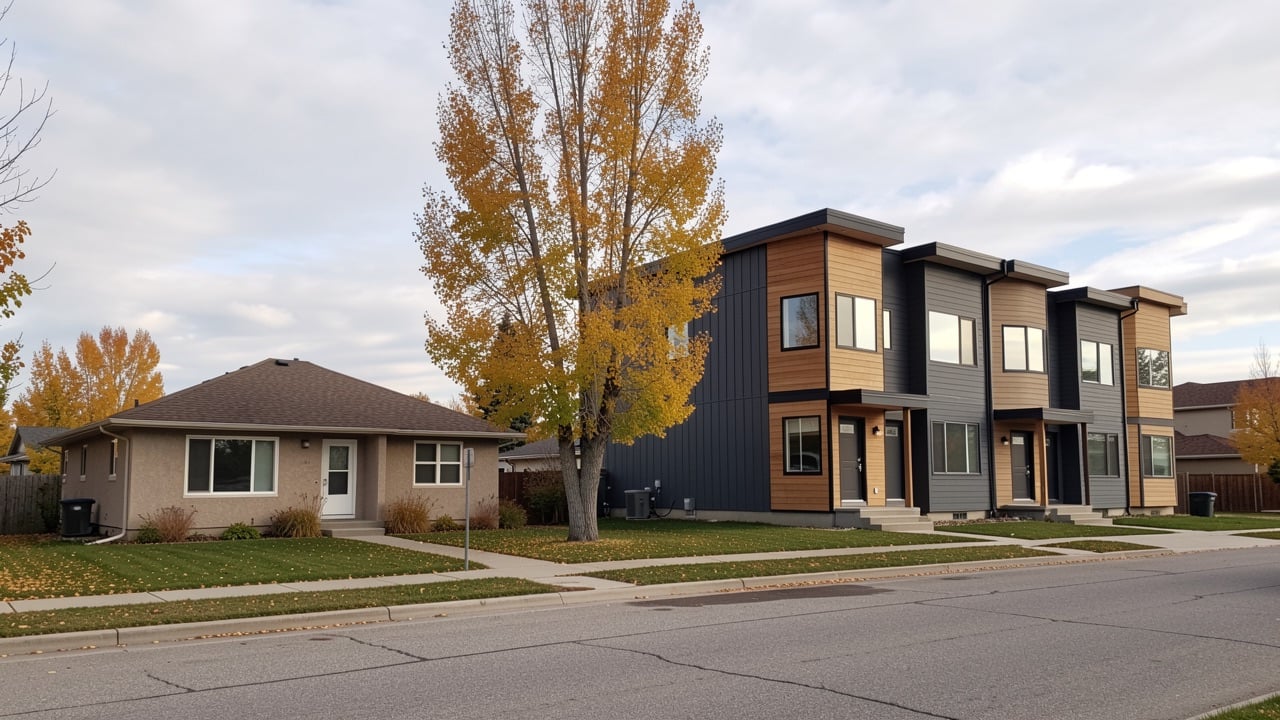
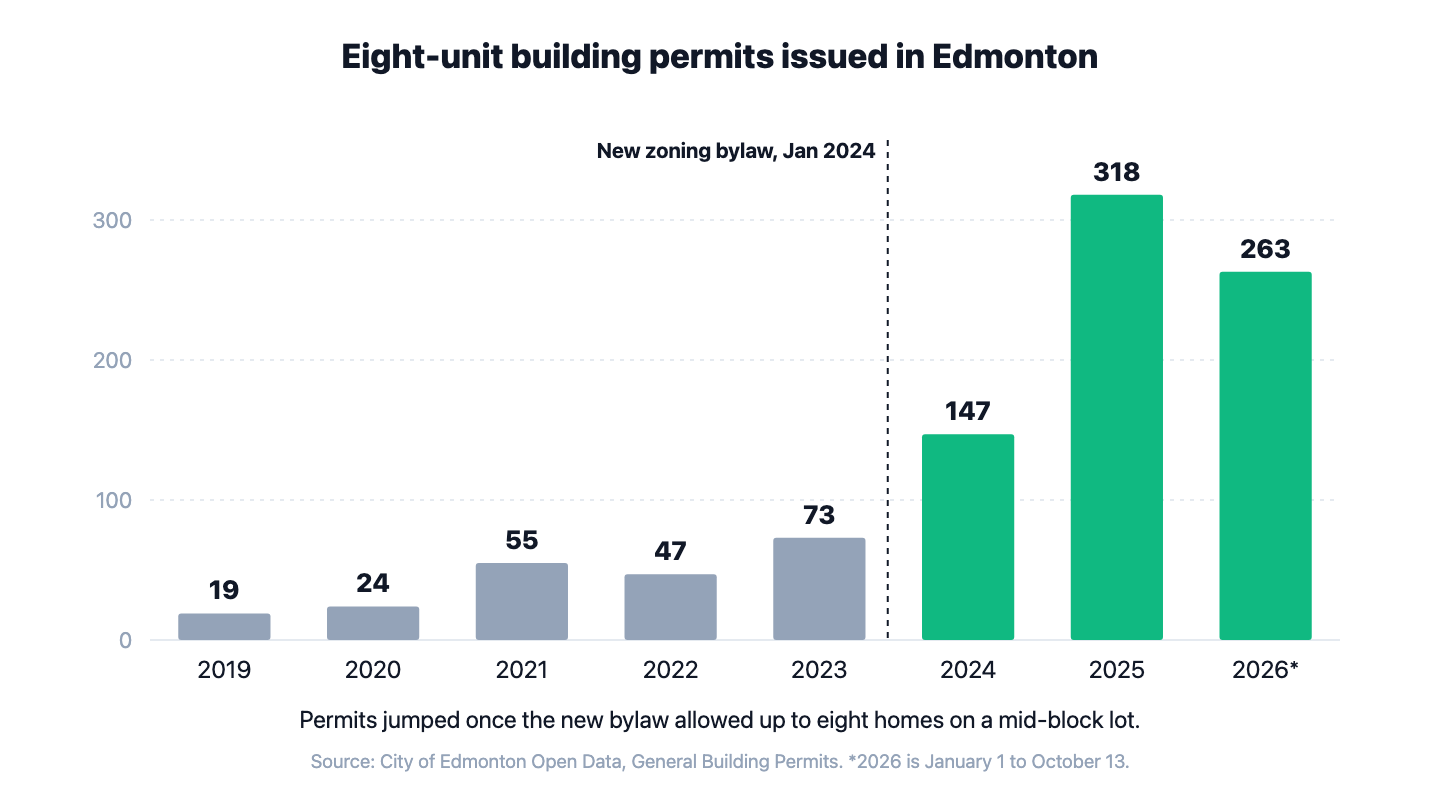
Since January 2024, Edmonton’s zoning bylaw has allowed up to eight homes on a mid-block lot that is big enough, and builders have used it. The City issued 318 building permits for eight-unit buildings in 2025, about 4.4 times the 73 it issued in 2023 (City of Edmonton Open Data).
If you own a house in a mature neighbourhood, or you’re thinking about buying in one, this page covers the questions that touch your mortgage: whether a multiplex next door changes your rate, what has happened to home values so far, what is still unknown, and what your options are.
Key Takeaways
- An eight-plex next door does not change your mortgage rate. Lenders price your mortgage on things like your term, your rate type and your credit history (FCAC).
- So far the assessment record shows no value penalty. Existing homes in the 10 neighbourhoods with the most eight-plexes rose a median 16.5% in assessed value from 2023 to 2026, compared with 14.9% in neighbourhoods with almost none.
- The most direct link to your mortgage is property tax. Lenders count it when they work out how much you can borrow, so a rising assessment trims your borrowing room a little.
- A lot is still unsettled, including a City report on the eight-unit limit expected in early 2027.
- If you already own, the same rules open up options, such as adding a suite with an insured refinance of up to 90% of the finished value (CMHC).
What does Edmonton’s infill zoning allow?
Zoning Bylaw 20001 took effect on January 1, 2024, after council approved it in October 2023 (City of Edmonton). Most neighbourhoods inside the Anthony Henday are zoned RS, Small Scale Residential (City of Edmonton). Here is what the RS zone allows today (Zoning Bylaw, Section 2.10):
- Up to eight homes on a mid-block lot. Each home needs at least 75 square metres of lot, so it takes a lot of 600 square metres or more to fit eight. Corner lots can hold more, depending on their size.
- A maximum height of 9.5 metres, about three storeys. Council lowered this from 10.5 metres on April 27, 2026, for development permits approved on or after August 1, 2026 (Bylaw 21474).
- Buildings can cover up to 45% of the lot.
- Limits on long side walls. On a mid-block lot, a building can run along the side lot line for no more than half the lot’s depth or 25 metres, whichever is less, with no more than two entrances facing the neighbouring house. Council added these rules in June 2025.
- No minimum parking. Edmonton has had open option parking citywide since 2020, so builders decide how many stalls to provide.
Not every lot qualifies. In February 2026, Mayor Andrew Knack told council that almost two-thirds of lots in the city do not allow buildings with eight units (Western Standard).
How many eight-plexes is Edmonton approving, and where?
Before the new bylaw, the City issued between 19 and 73 eight-unit permits a year. That rose to 147 in 2024 and 318 in 2025, and 263 more have been issued in 2026 as of October 13. That is 728 since the bylaw took effect.
They are not spread evenly. Ten mature neighbourhoods account for 257 of those 728 permits, about 35%:
| Neighbourhood | Eight-unit permits since 2024 |
|---|---|
| Glenwood | 39 |
| Sherwood | 31 |
| Inglewood | 29 |
| West Jasper Place | 27 |
| Britannia Youngstown | 27 |
| Prince Charles | 25 |
| High Park | 22 |
| Jasper Park | 20 |
| Rosenthal | 19 |
| Westmount | 18 |
Source: City of Edmonton Open Data, General Building Permits, permits recording exactly eight units added, January 1, 2024 to October 13, 2026.
Approved is not the same as built
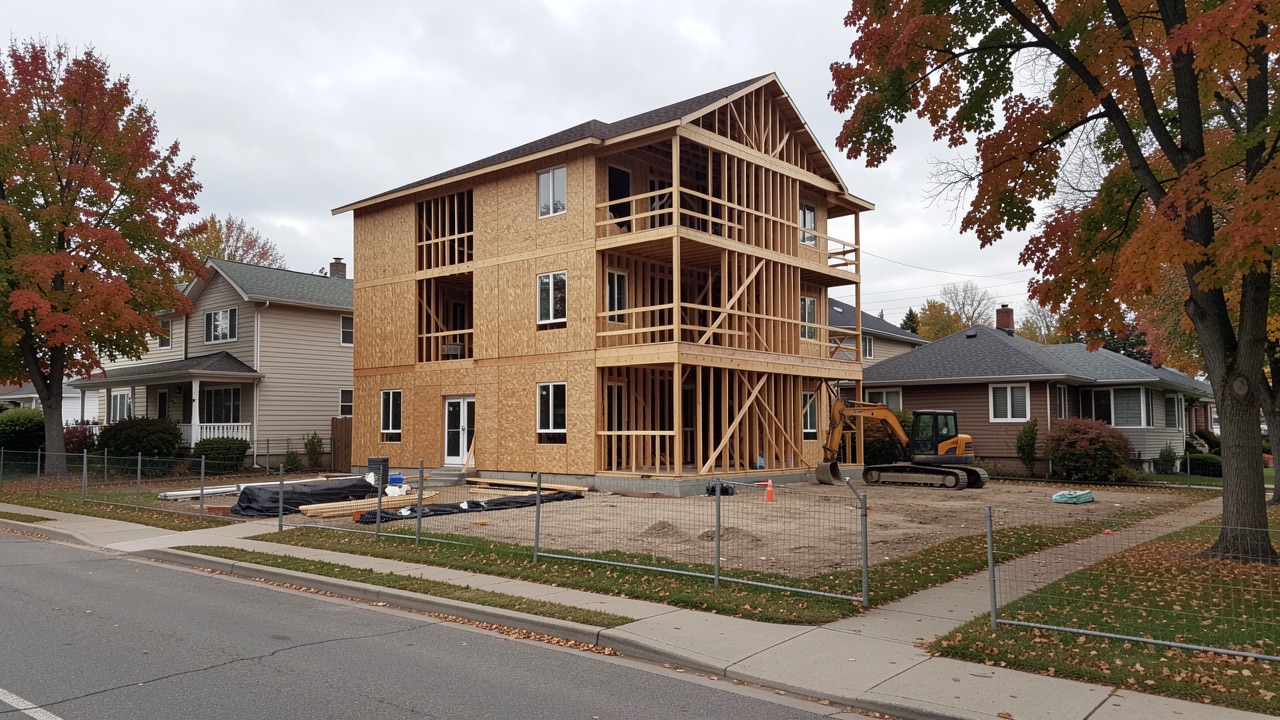
A permit is permission to build, not a finished building. The City’s records show how many of these buildings have been granted occupancy:
| Permit year | Eight-unit permits | Occupancy granted | Share |
|---|---|---|---|
| 2024 | 147 | 139 | 95% |
| 2025 | 318 | 175 | 55% |
| 2026 | 263 | 12 | 5% |
Some of the gap is normal construction time, which is why 2026 reads so low. The 2025 group is the one to watch: 55% have reached occupancy, compared with 95% of the 2024 group.
Does infill next door affect your mortgage rate?
No. The Financial Consumer Agency of Canada lists what lenders consider when they set your rate: the length of your term, their prime and posted rates, whether you qualify for a discount, fixed or variable, your credit history, and whether you’re self-employed (FCAC). What gets built on the next lot isn’t on that list. If you have a fixed rate today, it stays the same until your term ends.
The indirect route is your home’s value. That matters at the moments a lender looks at your property, such as when you buy, refinance or switch lenders, because value decides how much equity you have. Borrowers with less than 20% down need mortgage insurance, and the federal government notes that insurance gives eligible buyers access to “more affordable interest rates” (Department of Finance). If you have plenty of equity, a modest change in value is unlikely to change which options you qualify for. If you’re close to the line, it can.
Does infill hurt property values in Edmonton?
This is the question people ask most, and it usually gets answered with anecdotes. We went to the City’s own assessment records instead.
Comparing whole neighbourhoods before and after doesn’t work, because new eight-plexes are assessed too and push the average up on their own. So we compared the same individual homes in the 2023 and 2026 assessment rolls, matched by assessment account and limited to residential properties. A property had to exist in 2023 to count, so new construction is left out. What remains is what happened to homes that were already there.
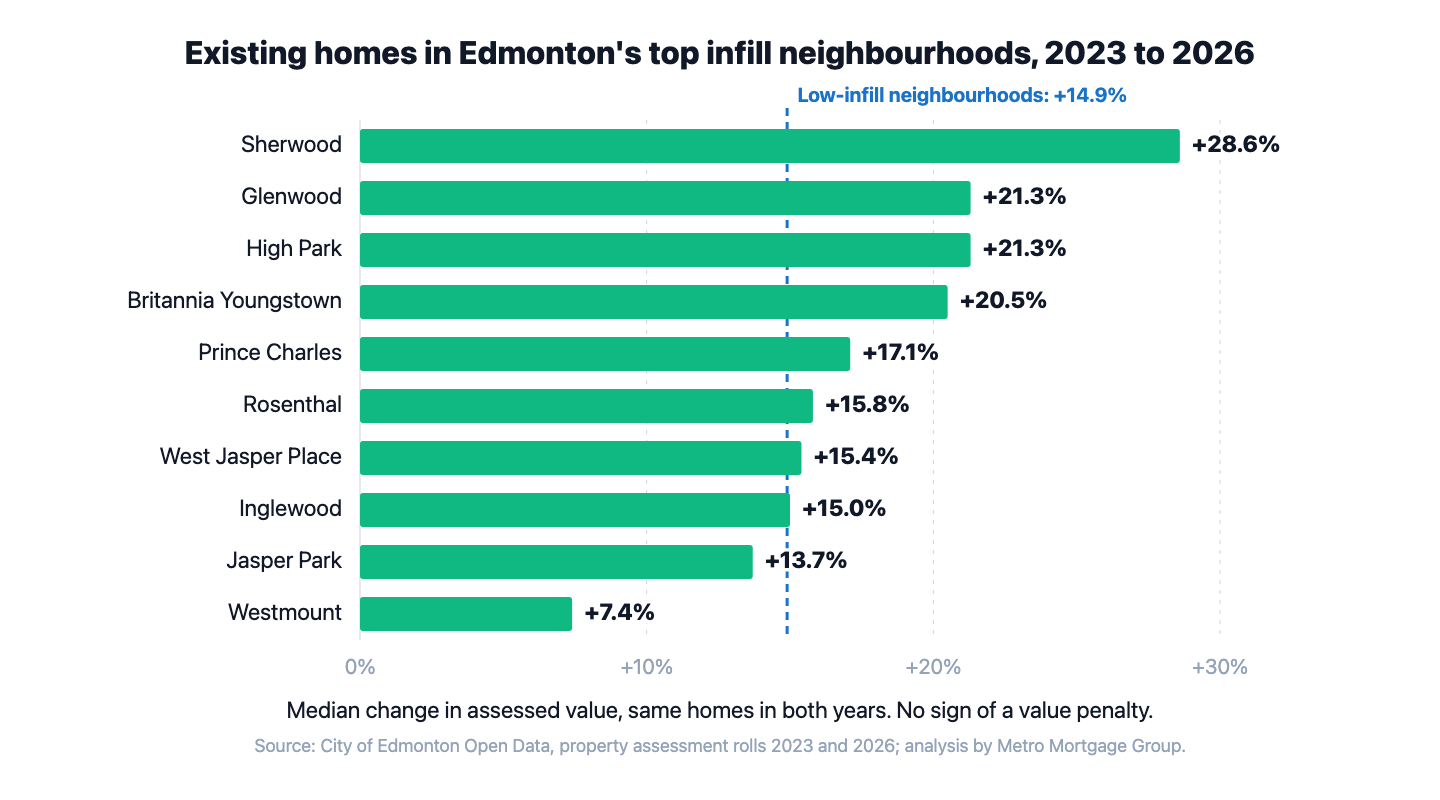
Neighbourhoods with the most eight-plexes (12,223 homes compared):
| Neighbourhood | Eight-unit permits since 2024 | Homes compared | Median assessed value, 2023 | Change to 2026 |
|---|---|---|---|---|
| Glenwood | 39 | 1,679 | $266,000 | +21.3% |
| Sherwood | 31 | 437 | $282,000 | +28.6% |
| Inglewood | 29 | 1,431 | $333,500 | +15.0% |
| West Jasper Place | 27 | 654 | $353,000 | +15.4% |
| Britannia Youngstown | 27 | 1,455 | $271,000 | +20.5% |
| Prince Charles | 25 | 576 | $293,500 | +17.1% |
| High Park | 22 | 617 | $311,500 | +21.3% |
| Jasper Park | 20 | 598 | $323,000 | +13.7% |
| Rosenthal | 19 | 2,157 | $426,000 | +15.8% |
| Westmount | 18 | 2,619 | $385,500 | +7.4% |
Neighbourhoods with one eight-unit permit or none (36,297 homes compared):
| Neighbourhood | Eight-unit permits since 2024 | Homes compared | Median assessed value, 2023 | Change to 2026 |
|---|---|---|---|---|
| Laurel | 0 | 4,271 | $425,500 | +18.1% |
| Windermere | 1 | 4,676 | $489,500 | +17.5% |
| Walker | 0 | 4,500 | $389,500 | +17.0% |
| South Terwillegar | 0 | 3,696 | $339,000 | +16.6% |
| Rutherford | 0 | 4,409 | $354,500 | +14.9% |
| Ambleside | 0 | 2,560 | $432,500 | +14.6% |
| The Hamptons | 0 | 3,945 | $418,500 | +13.7% |
| Strathcona | 1 | 2,907 | $279,500 | +5.5% |
| Downtown | 0 | 5,333 | $238,000 | -7.9% |
Existing homes in the high-infill neighbourhoods rose a median of 16.5%, compared with 14.9% where there was almost no infill. Nine of the 10 high-infill neighbourhoods posted double-digit gains.
Read that carefully, because it shows less than it seems to. The gap is 1.6 percentage points, which is small, and the two groups are different kinds of places: the high-infill list is mostly older central neighbourhoods, and the comparison list is mostly newer suburbs. That difference alone could explain the gap in either direction. These numbers describe what happened. They don’t prove what caused it.
What the record does not show is a value penalty. Homes in the neighbourhoods taking the most eight-plexes did not fall behind the rest of the city over this period.
Two more limits. An assessment is the City’s estimate of market value on July 1 of the year before, not a sale price (City of Edmonton), so the 2026 roll reflects values at July 1, 2025. And a neighbourhood median can’t tell you about one particular house beside one particular building.
Where infill can touch your mortgage: property tax
Your property tax is your assessed value multiplied by the tax rate. The 2026 residential rate in Edmonton is 0.0103637, about $1,036 for every $100,000 of assessed value (City of Edmonton). If your assessment rises faster than the rest of the city, your share of the tax bill rises with it.
That matters for borrowing because lenders count property tax as a housing cost. Under CMHC’s rules, principal, interest, property taxes and heating (plus half of any condo fees) generally shouldn’t exceed 39% of your gross household income, and all your debts together shouldn’t exceed 44% (CMHC). Those ratios are tested at the greater of your contract rate plus 2% or 5.25% (CMHC). Every extra dollar of tax is a dollar less that can go to your mortgage payment.
| Increase in assessed value | Added property tax at the 2026 rate | Effect on maximum mortgage |
|---|---|---|
| $10,000 | $104 a year ($9 a month) | about $1,300 less |
| $25,000 | $259 a year ($22 a month) | about $3,300 less |
| $50,000 | $518 a year ($43 a month) | about $6,600 less |
Illustrative only. Uses the 2026 residential tax rate, a 6.25% qualifying rate and a 25-year amortization. Your rate, income and tax bill will be different.
For most owners this only matters if you’re buying, refinancing or renewing with a new lender, and only if you need to borrow close to your limit. Check your assessment notice each January. In 2026 the City’s review period ran from January 12 to March 23, and that is the window to correct the information on your notice (City of Edmonton).
What we don’t know yet
A lot about infill is still unsettled. If anyone tells you exactly how it will play out, be skeptical. Here is what nobody can answer yet:
- Whether the limit stays at eight. Council has twice voted against cutting mid-block infill to six units: narrowly in 2025, and 8 to 4 on February 17, 2026 (Western Standard). A City report on the eight-unit maximum is expected in early 2027 (Taproot Edmonton), and the rules could change again after it.
- Whether the value pattern holds. Most of the eight-plexes permitted in 2025 and 2026 aren’t finished yet, and each assessment reflects values from July 1 of the year before. The next few assessment rolls will say more than this one can.
- How an appraiser will treat your house. We’re not aware of any public data on how appraisers value a home beside a new multiplex, and each appraisal is done on its own.
- Whether every permitted building gets built. 55% of the 2025 permits have reached occupancy so far.
- Parking and services. The councillor who moved to cut the limit to six cited capacity concerns about parking and waste management (Western Standard). How that plays out on a given street is not known.
- Restrictive covenants. The mayor has said residents in some neighbourhoods are seeking restrictive covenants to keep eight-plexes off their lots, and called them “a very valid legal tool” (Western Standard). What one means for a particular property is a question for a real estate lawyer.
- Builder costs. From January 1, 2027, many smaller infill projects inside the Anthony Henday must post a landscape security (Bylaw 21499). Whether that changes how much gets built is unknown.
Buying in an infill neighbourhood: what to check first
- Look up the zoning around the house. The City’s zoning map shows the zone for the home and the lots beside it. A neighbouring mid-block lot of 600 square metres or more in the RS zone could hold up to eight homes.
- See what’s already approved. Building permits are public on the City’s open data portal, and owners can sign up for email notices of development permits within 60 metres of their property (City of Edmonton).
- Know what your lender is looking at. Your approval is about the home you’re buying, your income and your credit. A permit next door isn’t part of it, and only comes into play if the appraiser thinks it affects value.
- If you’re buying a home inside a new multiplex, ask how it’s titled. The RS zone allows row houses on their own lots, as narrow as 4 to 5 metres, and those are bought much like any house. If the homes are condo units, lenders count half of the condo fees in your housing costs (CMHC). Units in a building held on one title as a rental can’t be bought individually.
- Watch the timeline on new construction. Possession dates can move. If you’re buying new, talk to us about how long you can hold a rate (we can hold one for up to 120 days) compared with when you’ll actually move in.
- Buying the whole building is a different mortgage. Residential mortgage insurance covers homes of up to four units (CMHC). An eight-plex is commercial financing, with different lenders and bigger down payments. See our commercial mortgage guide and investment property down payment requirements.
Already own? Your options
- Your current mortgage doesn’t change. Your rate, payment and term stay as they are no matter what is built nearby.
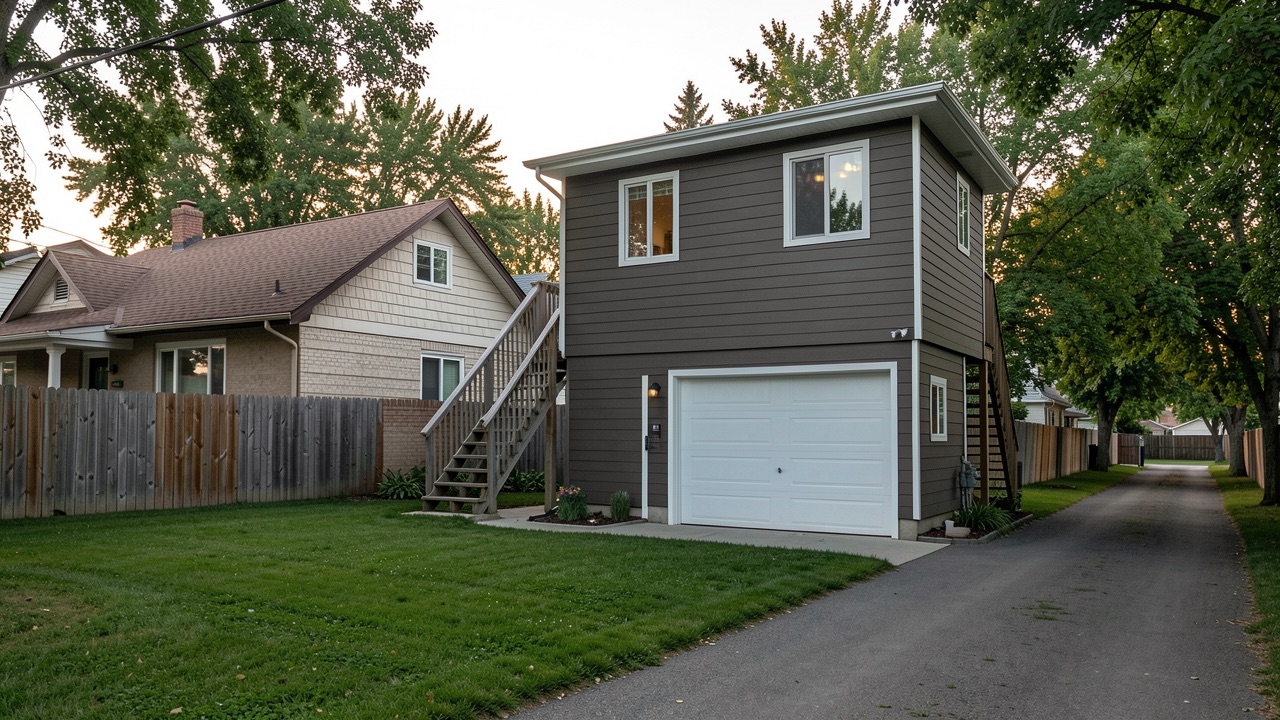
- You can add homes yourself. The RS zone allows backyard housing (what many people still call a garden suite) and more than one home on a lot. CMHC’s refinance program for secondary suites lets an owner borrow up to 90% of the property’s value once the suite is built, for up to four units in total including your own, on properties valued under $2 million, with amortization of up to 30 years. You or a close relative have to live in one of the units, and the new units can’t be rented for less than 90 days at a time (CMHC).
- You can borrow against your equity. If your home’s value has gone up, a refinance may let you use some of that equity. The lender will order its own appraisal. Your City assessment and an appraisal are not the same number.
- If a builder offers to buy your lot, treat it like any sale and get your own legal advice. If you plan to buy again, get pre-approved first so you know your budget before you sign.
- If your renewal is coming up, start early. Our mortgage renewal guide covers your options.
Work through your options with us
Every answer on this page depends on your own numbers: your equity, your income, your lot and what’s planned around it. We can run them with you, compare options across our 30+ lenders, and show you what’s possible before you commit to anything. Whether you’re weighing a purchase in an infill neighbourhood, thinking about adding a suite, or just want to know where you stand, call 780-974-1270, email info@MetroMortgageGroup.ca, or choose an advisor to get started. You can also read about our Edmonton mortgage broker team or the latest Edmonton housing market report.
About the author: Daniel De Sousa is co-owner of Metro Mortgage Group and an Edmonton mortgage broker. He works with buyers, renewals and refinances across Alberta.
How we did the analysis
All figures come from published City of Edmonton open data, and no client information is used. Permits come from the General Building Permits dataset; an eight-plex is a permit recording exactly eight units added. Assessed values come from the historical (2023) and current-year (2026) property assessment datasets. Homes are matched between the two rolls by assessment account number, limited to the residential tax class, and assessments under $50,000 are excluded to remove land-only records. The figure shown is the median change per home, so a few very high or very low values don’t skew the result. The high-infill group is the 10 neighbourhoods with the most eight-unit permits since 2024. The comparison group is nine neighbourhoods with one eight-unit permit or none.
Sources
- City of Edmonton Open Data, General Building Permits, Property Assessment Data (Historical) and Property Assessment Data (Current Calendar Year), retrieved 2026-10-13, https://data.edmonton.ca/
- City of Edmonton, Zoning Bylaw 20001, Section 2.10 RS Small Scale Residential Zone and Record of Text Amendments, retrieved 2026-10-13, https://zoningbylaw.edmonton.ca/
- City of Edmonton, Zoning Bylaw Renewal, https://www.edmonton.ca/city_government/urban_planning_and_design/zoning-bylaw-renewal
- City of Edmonton, Infill in Your Neighbourhood information sheet, https://www.edmonton.ca/sites/default/files/public-files/Infill-Information-Sheet.pdf
- City of Edmonton, Property Taxes (2026 tax rates, assessment review period), retrieved 2026-10-13, https://www.edmonton.ca/residential_neighbourhoods/property-taxes
- Financial Consumer Agency of Canada, Interest on mortgages, https://www.canada.ca/en/financial-consumer-agency/services/mortgages/interest-on-mortgages.html
- Department of Finance Canada, A New Benchmark Rate for Insured Mortgages (2020), https://www.canada.ca/en/department-finance/news/2020/02/a-new-benchmark-rate-for-insured-mortgages.html
- CMHC, General requirements to qualify for homeowner mortgage loan insurance, Purchase and Refinance for building secondary suites, retrieved 2026-10-13, https://www.cmhc-schl.gc.ca/
- Western Standard, Motion to reduce density in Edmonton infills defeated in council, February 18, 2026
- Taproot Edmonton, Edmonton city council passed big decisions and final motions before ending its term, September 26, 2025
Permit data current to October 13, 2026. Assessment comparison uses the 2023 and 2026 assessment rolls.