



Mortgage Renewal in Alberta: The Complete 2026 Guide
By Daniel De Sousa · Updated September 28, 2026 · Rates verified September 28, 2026

The Bank of Canada estimated in 2025 that people renewing a five-year fixed mortgage in 2026 would see their payment rise by about 20% on average (Bank of Canada, Staff Analytical Note 2025-21). Fixed rates have climbed since that estimate was published. As of September 28, 2026, the lowest advertised insured five-year fixed rate is 4.29%, up 25 basis points in the last 30 days (lender rate survey). If you signed a five-year fixed mortgage in 2021, the increase in front of you is probably larger than the Bank’s average.
The number on your renewal letter isn’t fixed, though. The rate, the lender, the term and the amortization are all open to negotiation. Most people sign the form their lender mails them, and that tends to be the most expensive way to renew.
Key Takeaways
– About 60% of all outstanding Canadian mortgages renew in 2025 or 2026 (Bank of Canada, 2025).
– A $450,000 mortgage signed at 1.89% in 2021 renews for about $448 more a month at today’s 4.29% fixed rate, an increase of roughly 24%.
– The best five-year variable rate (3.25%) now sits 104 basis points below fixed, which is about $200 a month less on the same renewal at today’s rates.
– Since November 21, 2024, federally regulated lenders don’t have to stress test an uninsured straight switch at renewal (OSFI).
– Start about 120 days before your maturity date, while you still have time to compare offers.
What is happening to Alberta renewals in 2026?
About 60% of all outstanding mortgages in Canada renew in 2025 or 2026, according to the Bank of Canada’s 2025 analysis, and around 60% of those borrowers will see their payment go up (Bank of Canada, Staff Analytical Note 2025-21). The group is unusually large because so many people bought or refinanced during the 2020 and 2021 rate lows.
In 2021 the Bank of Canada’s policy rate sat at 0.25%, and five-year fixed rates were among the lowest on record. The example below uses a 2021 rate of 1.89%. Against today’s 4.29%, that’s a gap of 240 basis points, and it drives almost everything in this guide.
Your finances may have improved over the term. Your income is probably higher, you’ve made five years of payments, and you’ve built equity. The rate environment changed anyway. Equity does help at renewal, because lenders compete harder for borrowers with more of it.
How much will your payment go up?
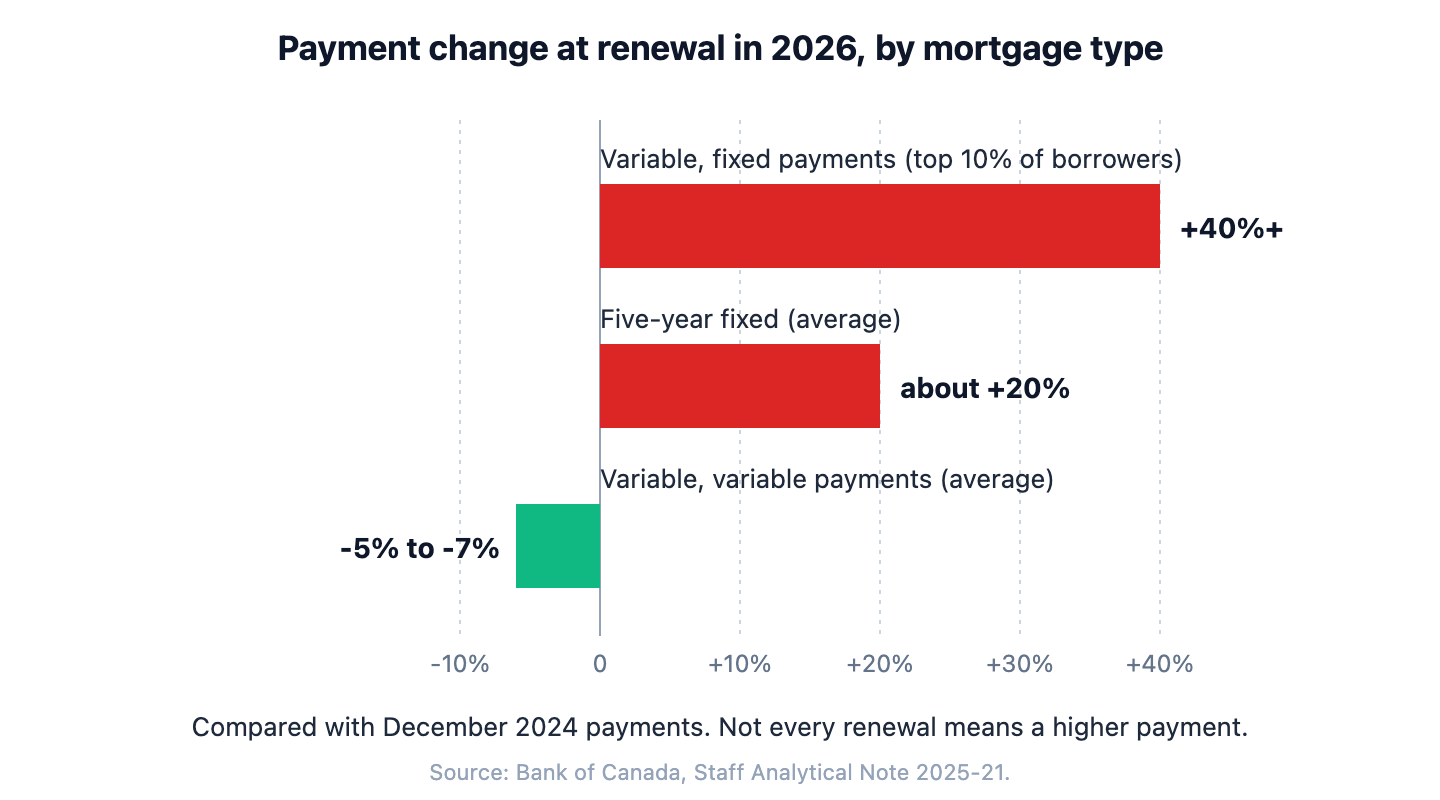
The Bank of Canada’s 2025 analysis projected an average increase of about 20% for five-year fixed borrowers renewing in 2026, a decrease of about 5% to 7% for variable borrowers whose payments float, and increases above 40% for the top 10% of variable borrowers on fixed payments (Bank of Canada).
Here’s a worked Alberta example, calculated with Canadian semi-annual compounding.
A $450,000 mortgage taken in 2021 at 1.89% over 25 years had a payment of about $1,882 a month. After five years of payments the balance is about $376,100. Renewing that balance over the remaining 20 years gives these payments at today’s best advertised rates:
| Option | Rate | Monthly payment | Change from 2021 |
|---|---|---|---|
| 2021 term | 1.89% | $1,882 | |
| Renew, five-year fixed | 4.29% | $2,329 | +$448 (+23.8%) |
| Renew, three-year fixed | 4.19% | $2,310 | +$428 (+22.7%) |
| Renew, five-year variable | 3.25% | $2,129 | +$247 (+13.1%) |
| Renew, five-year fixed, stretched back to 25 years | 4.29% | $2,038 | +$156 (+8.3%) |
The fixed-rate result is higher than the Bank’s 20% average because fixed rates rose after that analysis was published. Five years of payments also cut the balance by about $74,000, so you’re renewing a smaller mortgage than you started with.
Why is the renewal offer from your lender rarely the best rate?
Federal research on renewal behaviour found that 20% of mortgage holders had not compared lenders at all, while 36% said someone else, such as a mortgage broker, shopped around for them (Financial Consumer Agency of Canada).
A lender that knows a share of its customers will sign whatever arrives in the mail has little reason to open with its sharpest rate. Better pricing tends to go to borrowers who ask for it, or who have a broker asking for them.
When a client sends us a renewal letter, we compare it against current pricing across our panel of 30+ lenders. Sometimes the existing lender improves its offer once it sees a competing quote. Either way, the client decides with real numbers in front of them.
Small rate differences add up. On a $376,100 balance, a rate 25 basis points lower saves about $4,400 in interest over a five-year term.
Can you switch lenders without the stress test?
Often, yes. Since November 21, 2024, the Office of the Superintendent of Financial Institutions no longer requires its minimum qualifying rate for an uninsured straight switch, meaning you move your mortgage from one federally regulated lender to another at renewal without increasing it (OSFI). Lenders still underwrite the file under OSFI’s Guideline B-20.
Before that change, switching an uninsured mortgage meant qualifying at a rate about two percentage points above the contract rate. Households that could comfortably afford their real payment sometimes failed that test, so they stayed with their lender by default.
Check the conditions before you plan around it:
- It covers straight switches. If you add to the balance or extend the amortization, it becomes a refinance and you’ll need to qualify.
- It applies to federally regulated lenders. Credit unions regulated by the province, such as many in Alberta, set their own rules.
- It’s OSFI’s rule for uninsured mortgages. If your mortgage is insured (less than 20% down when you bought), ask the new lender how it treats a straight switch before you apply.
- A switch takes paperwork and processing time, so starting late can leave you with only your current lender’s offer.
What if the new payment doesn’t fit your budget?
You have several options. They’re listed roughly from least to most expensive over time.
Use your prepayment privileges before maturity. A lump sum applied before renewal shrinks the balance the new rate applies to. Our guide to prepayment privileges covers what most lenders allow.
Consider variable if your budget can handle movement. At 3.25% against 4.29% fixed, variable starts about $200 a month lower on the example above. The payment or the amortization can change if rates move.
Look at a shorter term. The best three-year fixed rate is 4.19%. A shorter term avoids committing to today’s fixed rates for five years.
Stretch the amortization. Going from 20 years back to 25 brings the example payment down to about $2,038. You’ll pay more interest over the life of the mortgage, and it counts as a refinance, so qualification applies.
Refinance to consolidate debt. If higher-interest debt is part of the pressure, rolling it into the mortgage can lower total monthly payments. This is also a refinance and needs qualifying.
The one option that asks nothing of your lender is signing the renewal letter as written, so it should be the last one you consider rather than the first.
When should you start the renewal process?
Start about 120 days before your maturity date. That’s when most lenders will hold a rate for you. If rates rise before your renewal date you keep the held rate, and if they fall you can usually take the lower one.
| Timing | What to do |
|---|---|
| 120 days out | Ask your lender for its renewal offer in writing and request a rate hold. |
| 90 days out | Get comparison quotes. Compare the rate, prepayment terms and penalty rules. |
| 60 days out | Decide whether to stay, switch or restructure, and start paperwork on a switch. |
| 30 days out | Confirm the new payment and the first payment date. |
| Maturity | The new term starts. |
Waiting for the renewal letter to arrive is the most common mistake we see. By then you may have less than 30 days, and convenience usually wins. Our guide on when to lock your mortgage rate covers the timing in more detail.
Fixed or variable at renewal right now?
The Bank of Canada held its policy rate at 2.25% on September 2, 2026, noting that CPI inflation had been hovering around 3%, mainly because of higher gasoline prices (Bank of Canada). Prime is 4.45%, the best five-year variable is 3.25%, and the best insured five-year fixed is 4.29% (lender rate survey).
A renewing borrower usually has a different problem from a buyer. A buyer choosing variable is often betting on where rates go. Someone renewing is usually trying to make a higher payment fit. If the fixed payment fits your budget and you want certainty for five years, that certainty is worth paying for. If the fixed payment is tight, variable’s lower start does real work, and that’s a reasonable reason to take it.
The gap between the two is the widest it’s been this year. Variable is 104 basis points cheaper, so the variable rate would have to rise by about four quarter-point steps before its payment reached today’s fixed payment. The Bank’s next decisions are October 28 and December 9.
Fixed rates follow the five-year Government of Canada bond yield rather than the Bank of Canada’s rate. That yield was about 3.68% on September 28 (Trading Economics), which is why fixed rates rose while the Bank held. Our five-year fixed rate guide explains how that works, and our fixed versus variable comparison walks through the trade-offs.
Frequently asked questions
How much will my mortgage payment go up at renewal in 2026?
The Bank of Canada projected about 20% on average for five-year fixed borrowers renewing in 2026. Fixed rates have risen since, and our Alberta example renewing $376,100 from 1.89% to 4.29% comes to about $448 more a month, or 23.8%. Variable borrowers generally see smaller increases.
Do I have to pass the stress test to switch lenders at renewal?
Not for an uninsured straight switch between federally regulated lenders, since November 21, 2024. The balance and amortization must stay the same. If you borrow more or extend the amortization, it becomes a refinance and you’ll need to qualify. For an insured mortgage, confirm with the new lender first.
When should I start my mortgage renewal in Alberta?
About 120 days before your maturity date. That’s when most lenders will hold a rate, which protects you if rates rise and usually lets you take a lower rate if they fall. With 30 days or less left, most people end up accepting their current lender’s offer.
Is it worth switching lenders for a small rate difference?
Usually. On a $376,100 balance, a rate 25 basis points lower saves about $4,400 in interest over five years. Set that against any legal or discharge costs, and ask whether the new lender covers those on a switch. Some lenders do.
Should I choose fixed or variable at renewal?
The best insured five-year fixed rate is 4.29% and the best five-year variable is 3.25%, a gap of 104 basis points. Choose fixed if a predictable payment matters most to you. Choose variable if your budget can absorb changes and you want the lower starting payment.
Talk to us about your renewal
If your mortgage matures in the next six months, find your maturity date and get a comparison before you sign anything. We’ll compare your lender’s offer with current pricing across our 30+ lenders, run the payments against your budget, and tell you whether the offer is competitive.
Call 780-974-1270 or email info@MetroMortgageGroup.ca. We work with homeowners across Edmonton and Calgary, and you can check today’s Edmonton mortgage rates before you call. Buying instead of renewing? Start with our first-time home buyer guide.
About the author: Daniel De Sousa is co-owner of Metro Mortgage Group and an Edmonton mortgage broker. He works with first-time buyers, renewals and pre-approvals across Alberta.
Sources
- Bank of Canada, Staff Analytical Note 2025-21: How will mortgage payments change at renewal? An updated analysis, retrieved 2026-09-28, https://www.bankofcanada.ca/2025/07/staff-analytical-note-2025-21/
- Bank of Canada, Policy interest rate announcement, September 2, 2026, retrieved 2026-09-28, https://www.bankofcanada.ca/2026/09/fad-press-release-2026-09-02/
- Office of the Superintendent of Financial Institutions, OSFI exempts uninsured mortgage straight switches from the prescribed MQR, retrieved 2026-09-28, https://www.osfi-bsif.gc.ca/en/guidance/guidance-library/osfi-exempts-uninsured-mortgage-straight-switches-prescribed-mqr-implements-portfolio-lti-limits
- Financial Consumer Agency of Canada, Exploring consumer behaviour in mortgage renewal, retrieved 2026-09-28, https://fcac-research-recherche-acfc.canada.ca/en/canada-finance/data-story-histoire-donnees/?id=c1daed30-f9ef-f011-8407-7ced8de0946a
- Lender rate survey, lowest advertised Canadian mortgage rates, retrieved 2026-09-28, https://wowa.ca/mortgage-rates
- Trading Economics, Canada 5-Year Bond Yield, retrieved 2026-09-28, https://tradingeconomics.com/canada/5-year-note-yield
Rates last verified September 28, 2026. Rates change often; call for a current quote.