



Blend and Extend Mortgage: How It Works and When It Makes Sense
By Daniel De Sousa · Published October 20, 2026 · Rates verified September 28, 2026

A blend and extend lets you start a new mortgage term before your current one ends, at a rate that mixes your existing rate with the lender’s rate for the new term. The Financial Consumer Agency of Canada says that when you choose this option, lenders blend your old interest rate and the new term’s rate, and you don’t have to pay a prepayment penalty, though you may pay administrative fees (Financial Consumer Agency of Canada).
Whether it helps you depends almost entirely on one thing: whether your current rate is above or below today’s rates.
Key Takeaways
– A blend and extend resets your term early with no prepayment penalty, although administrative fees may apply (Financial Consumer Agency of Canada).
– Your new rate falls between your current rate and the lender’s rate for the new term.
– If your current rate is above today’s rates, blending can lower your payment without a penalty.
– If your current rate is below today’s rates, blending raises your rate now, and it only pays off if rates are higher at your original maturity than they are today.
How does a blend and extend work?
You stay with your current lender and sign up for a new term before the old one ends. Instead of paying a penalty to break the mortgage, you take a rate that blends the two:
- The rate on your existing mortgage for the months left on the current term.
- The lender’s current rate for the months you’re adding.
The Financial Consumer Agency of Canada describes this as an early renewal that lenders call a blend-and-extend, because the old and new rates are blended (Financial Consumer Agency of Canada). If the blended rate is lower than what you pay now, you can reduce your regular payments, or keep them the same and pay off the mortgage faster.
How is the blended rate calculated?
Lenders use their own formulas, and many weight the rates by time remaining and by balance. A simplified version that shows the idea weights each rate by the months it covers.
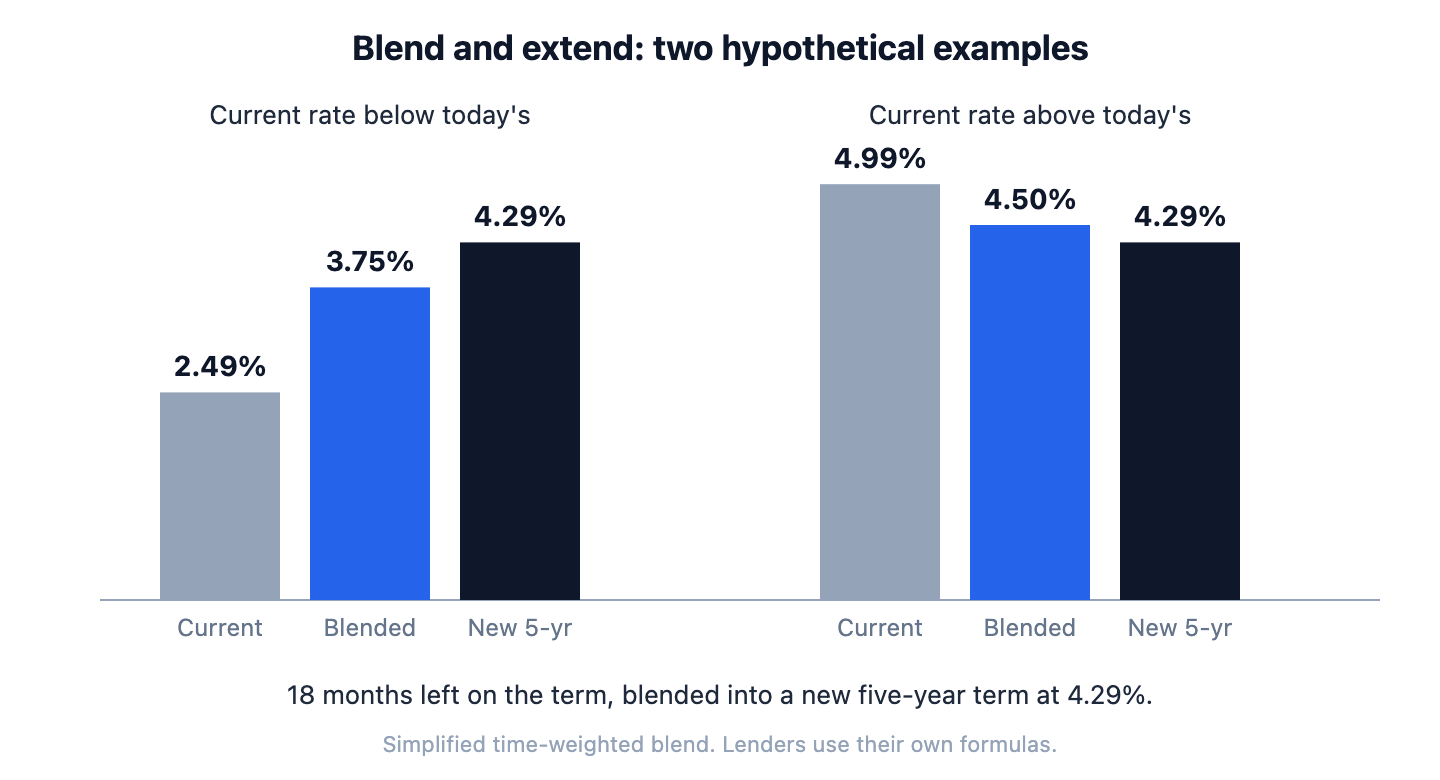
Take a hypothetical mortgage with a $380,000 balance at 2.49% and 18 months left on the term. The lender offers a new five-year term, and its five-year rate matches the lowest advertised insured rate of 4.29% as of September 28, 2026 (lender rate survey).
- 18 months at 2.49%
- 42 months at 4.29% (the rest of the new 60-month term)
- Blended rate: (2.49% × 18 + 4.29% × 42) ÷ 60 = 3.75%
Your lender’s figure may differ from this simplified method, so ask the lender to show you how it calculated your blended rate before you sign.
Does a blend and extend make sense when rates are rising?
Only in specific cases. In the example above, blending raises the rate from 2.49% to 3.75% right away. Over the 18 months left on the original term, that’s roughly $7,182 in extra interest, and the payment on a 20-year remaining amortization goes from about $2,009 to about $2,247 a month.
What you get in return is a 3.75% rate for the full five years. Under the simplified blend, that only comes out ahead if the five-year rate at your original maturity, 18 months from now, is higher than today’s 4.29%. If rates are lower by then, waiting would have been cheaper. The blend is essentially a bet that rates will keep rising.
It can still be reasonable if payment certainty matters more to you than the expected cost, or if you want to add money to the mortgage and your lender offers that with a blend. For most people with a low 2021 rate, waiting and arranging a rate hold near maturity costs less. Our guide to early mortgage renewal compares those options.
When does a blend and extend lower your payment?
When your current rate is above today’s rates. Take the same $380,000 balance with 18 months left, but a hypothetical current rate of 4.99%. Blending with a 4.29% five-year rate gives:
- Blended rate: (4.99% × 18 + 4.29% × 42) ÷ 60 = 4.50%
- Payment on a 20-year remaining amortization: about $2,495 now, about $2,396 blended, a drop of about $99 a month
- Interest over the next 18 months: about $2,793 less than staying at 4.99%
Because there’s no prepayment penalty, the borrower gets part of today’s lower rate straight away, rather than paying three months’ interest or an interest rate differential to break the mortgage.
All figures are hypothetical, use a simplified time-weighted blend and Canadian semi-annual compounding, and exclude any administrative fees.
What should you ask your lender before you blend?
- How exactly is the blended rate calculated, and which rate is used for the new term: the posted rate or a discounted rate?
- Are there administrative fees?
- What term lengths can you blend into?
- Can you add money to the mortgage at the same time, and how is that priced?
- What would the prepayment penalty be if you broke the mortgage instead? Compare both options on the same numbers.
It’s also worth comparing the blend against switching lenders at maturity. Our mortgage renewal guide covers switching, and our guide to prepayment privileges explains what you can pay down without a penalty.
Frequently asked questions
Is there a penalty for a blend and extend?
No prepayment penalty. The Financial Consumer Agency of Canada says you don’t have to pay a prepayment penalty when you choose a blend-and-extend, although you may have to pay administrative fees. Ask your lender for the fees in writing.
How is a blend and extend rate calculated?
It combines your current rate for the time left on your term with the lender’s rate for the added time. Lenders use their own formulas, often weighted by time and balance. In a simplified example, 18 months at 2.49% and 42 months at 4.29% blend to about 3.75%.
Is a blend and extend a good idea?
It helps most when your current rate is higher than today’s rates, because you lower your rate without a penalty. When your current rate is lower than today’s, blending raises your rate now and only pays off if rates keep rising.
Can I blend and extend with a different lender?
No. A blend and extend is done with your current lender. To move to a different lender before your term ends, you would normally break the mortgage and pay a prepayment penalty, or wait until maturity and switch then.
Get a second opinion on a blend offer
If your lender has offered you a blend and extend, send us the numbers. We’ll check the blended rate, compare it with waiting until maturity and with offers across our 30+ lenders, and tell you plainly which costs less. Call 780-974-1270 or email info@MetroMortgageGroup.ca.
About the author: Daniel De Sousa is co-owner of Metro Mortgage Group and an Edmonton mortgage broker. He works with first-time buyers, renewals and pre-approvals across Alberta.
Sources
- Financial Consumer Agency of Canada, Breaking your mortgage contract, retrieved 2026-09-28, https://www.canada.ca/en/financial-consumer-agency/services/mortgages/break-mortgage-contract.html
- Financial Consumer Agency of Canada, Paying off your mortgage faster, retrieved 2026-09-28, https://www.canada.ca/en/financial-consumer-agency/services/mortgages/pay-mortgage-faster.html
- Lender rate survey, lowest advertised Canadian mortgage rates, retrieved 2026-09-28, https://wowa.ca/mortgage-rates
Rates last verified September 28, 2026.