



Early Mortgage Renewal in Alberta: Should You Renew Before Your Term Ends?
By Daniel De Sousa · Published October 13, 2026 · Rates verified September 28, 2026

Early renewal means acting on your mortgage before your term ends, either by renewing with your current lender ahead of schedule or by breaking the mortgage to move somewhere else. With the best insured five-year fixed rate at 4.29% as of September 28, 2026, up 25 basis points in 30 days (lender rate survey), many homeowners with a term ending in the next year are asking whether to lock in now.
For most people with a low rate from 2021, the answer is to wait for the renewal window rather than giving up that rate early. The exceptions are covered below.
Key Takeaways
– A federally regulated lender must send your renewal statement at least 21 days before your term ends, and if you do nothing, your mortgage may renew automatically (Financial Consumer Agency of Canada).
– Breaking a closed mortgage usually costs the higher of three months’ interest or the interest rate differential (Financial Consumer Agency of Canada).
– A blend-and-extend lets you renew early with your current lender without a prepayment penalty, though administrative fees may apply (Financial Consumer Agency of Canada).
– If your current rate is below today’s rates, renewing early usually means paying a higher rate sooner. A rate hold near the end of your term often protects you at a lower cost.
What does early mortgage renewal mean?
There are two ways to act before your term ends, and they work very differently.
Renewing early with your current lender. Some lenders let you extend your mortgage before the term ends. The Financial Consumer Agency of Canada says lenders call this option the blend-and-extend, because your old rate and the new term’s rate are blended, and that with this option you don’t pay a prepayment penalty, although you may pay administrative fees (Financial Consumer Agency of Canada). Many lenders also let you renew without penalty in the last few months of your term. Ask your lender how long its window is.
Breaking the mortgage to switch lenders or restructure. If you leave a closed mortgage before the term ends, you normally pay a prepayment penalty, and it can cost thousands of dollars (Financial Consumer Agency of Canada).
What does it cost to break your mortgage early?
The penalty is usually the higher of three months’ interest on what you still owe or the interest rate differential (IRD). Lenders typically use the IRD when your mortgage rate is higher than current rates and you signed your contract less than five years ago (Financial Consumer Agency of Canada). The calculation varies from lender to lender.
If you locked in a low fixed rate in 2021, today’s rates are higher than yours, so the IRD is unlikely to apply and the penalty would usually be three months’ interest. On a hypothetical $380,000 balance at 2.49%, three months’ interest is about $2,366.
The penalty isn’t the only cost. Breaking early also means giving up your low rate for the months left on your term.
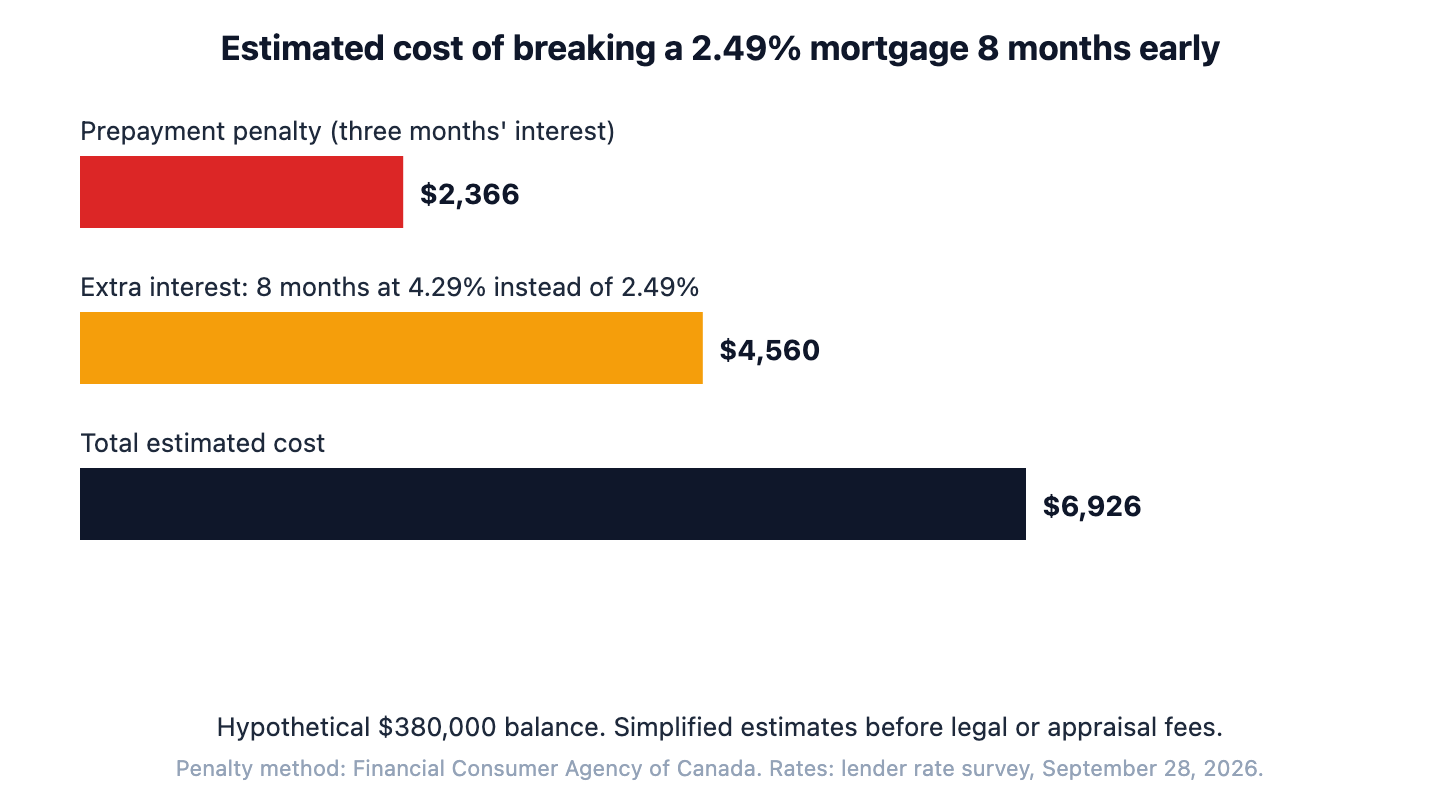
On the same hypothetical mortgage with eight months left, paying 4.29% instead of 2.49% for those eight months costs roughly $4,560 in extra interest. Add the $2,366 penalty and breaking early costs close to $6,900 before any legal or appraisal fees. That’s the price of locking today’s rate eight months sooner.
Figures are simplified estimates on a constant balance and don’t reflect any specific lender’s calculation.
When does renewing early make sense?
Early action tends to make sense when:
- Your current rate is higher than today’s rates. Then the IRD may apply, but moving to a lower rate can still come out ahead. Ask your lender for the exact penalty and compare.
- You need to borrow more, for example to consolidate debt or renovate. That’s a refinance, and it may be worth doing before the term ends if the savings on higher-interest debt outweigh the penalty.
- You’re selling or moving and your mortgage can’t be ported.
- You want certainty and can live with a higher rate sooner. A blend-and-extend lets you lock in without a penalty, at a blended rate between your old rate and today’s.
It tends not to make sense when your current rate is well below today’s, which describes most people who renewed or bought in 2021. In that case, the months you have left at the lower rate are worth keeping.
How do you protect yourself from rising rates without renewing early?
Use a rate hold instead. Lenders typically hold a rate for 60 to 130 days, depending on the lender (Financial Consumer Agency of Canada). If you arrange a hold about four months before maturity, you’re protected if rates keep rising, you keep your current rate until then, and you avoid a penalty.
Don’t let the deadline pass without acting. A federally regulated lender must send your renewal statement at least 21 days before the term ends, and it will say if the lender plans to renew you automatically (Financial Consumer Agency of Canada). You don’t have to renew with the same lender, but three weeks is a short window to compare offers.
Our mortgage renewal guide has a full timeline, and our guides on when to lock your rate and prepayment privileges cover the related decisions.
If you’re partway through your term, our guide to blend and extend explains how lenders combine your current rate with today’s rate, and when that makes sense.
Frequently asked questions
Can I renew my mortgage early without a penalty?
Often, yes, if you stay with your current lender. The Financial Consumer Agency of Canada says a blend-and-extend lets you renew before your term ends without a prepayment penalty, though administrative fees may apply. Many lenders also allow penalty-free renewal in the last few months of a term. Ask your lender for its window.
How early can I renew my mortgage?
It depends on the lender. Some offer early renewal at any time through a blend-and-extend, and many allow a standard renewal in the final few months of the term. Your lender must send a renewal statement at least 21 days before the term ends if it’s federally regulated.
Is it worth breaking my mortgage to lock in a rate now?
Usually not if your current rate is lower than today’s. On a hypothetical $380,000 balance at 2.49% with eight months left, breaking early would cost about $6,900 in penalty and extra interest. A rate hold closer to maturity usually protects you for much less.
What happens if I don’t renew my mortgage?
If you take no action, your mortgage may renew automatically, and your lender will say so in the renewal statement. You don’t have to renew with the same lender, but you need to act before the term ends to switch.
Talk to us before your term ends
If your mortgage matures within the next year, we’ll look at your current rate, the penalty, and your options across our 30+ lenders, and tell you whether acting early is worth it or whether a rate hold is enough. Call 780-974-1270 or email info@MetroMortgageGroup.ca. You can also check today’s Edmonton mortgage rates.
About the author: Daniel De Sousa is co-owner of Metro Mortgage Group and an Edmonton mortgage broker. He works with first-time buyers, renewals and pre-approvals across Alberta.
Sources
- Financial Consumer Agency of Canada, Renewing your mortgage, retrieved 2026-09-28, https://www.canada.ca/en/financial-consumer-agency/services/mortgages/renew-mortgage.html
- Financial Consumer Agency of Canada, Breaking your mortgage contract, retrieved 2026-09-28, https://www.canada.ca/en/financial-consumer-agency/services/mortgages/break-mortgage-contract.html
- Financial Consumer Agency of Canada, Mortgage fees: Prepayment penalties, retrieved 2026-09-28, https://www.canada.ca/en/financial-consumer-agency/services/mortgages/reduce-prepayment-penalties.html
- Financial Consumer Agency of Canada, Getting preapproved for a mortgage, retrieved 2026-09-28, https://www.canada.ca/en/financial-consumer-agency/services/mortgages/preapproval-qualify-mortgage.html
- Lender rate survey, lowest advertised Canadian mortgage rates, retrieved 2026-09-28, https://wowa.ca/mortgage-rates
Rates last verified September 28, 2026.