



Buying a Condo in Edmonton: What to Check Before You Commit
Buying a condo in Edmonton means making two decisions at once: the unit you’d live in, and the condo corporation you’d be joining. This guide looks at both from the financing side. It covers what condos sell for, what you need down, how the monthly fee changes your approval, and which documents to ask for before your financing condition ends.
If you’re earlier in the process, start with our first-time home buyer guide.
Key Takeaways
– In September 2026, Greater Edmonton Area apartment condos averaged $208,672, against $569,820 for a detached home (REALTORS® Association of Edmonton).
– At that price the minimum down payment is 5% (CMHC), or $10,434, and CMHC’s 4.00% insurance premium brings the insured mortgage to about $206,168 (CMHC).
– CMHC counts 50% of condo fees inside its 39% housing-cost limit. In our example, each $100 a month in fees cuts borrowing by about $7,600.
– Alberta condo corporations must answer a written document request within 10 days unless their bylaws say otherwise, and an estoppel certificate costs up to $200, or $300 on a rush basis (Government of Alberta).
– Alberta condo corporations generally need a reserve fund study every five years (Government of Alberta).
What do condos cost in Edmonton right now?
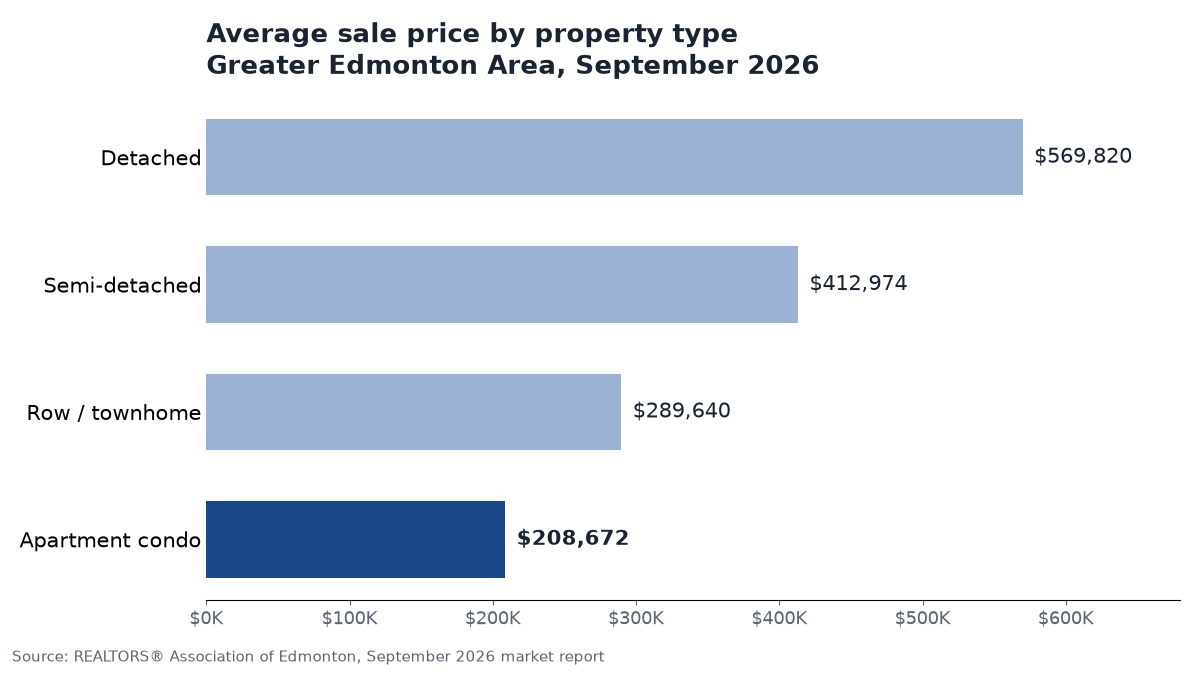
In September 2026, apartment condominiums in the Greater Edmonton Area sold for an average of $208,672, according to the REALTORS® Association of Edmonton. That’s the lowest of the four property types in the board’s report, and well below the row and townhome average of $289,640 for the same month.
Move up a property type and the gap widens quickly. Semi-detached homes averaged $412,974 in September and detached homes $569,820. If you’re weighing a condo against a starter house, that spread is the first number to look at.
Condo prices barely moved over the year. The September average was down 3.1% from August but up 0.6% from September 2025. Activity cooled more than prices did: apartment condo sales were 15.4% below a year earlier, and new condo listings fell 11.1% from August.
An average can’t tell you anything about a particular building. The documents later in this guide do that. See also our earlier look at Edmonton’s condo market in 2026, or our Edmonton housing market report for every property type.
So what does it take to finance a condo at that average price?
How much do you need down on a typical Edmonton condo?
On a home priced at $500,000 or less, the minimum down payment is 5%, according to CMHC. On the September 2026 Greater Edmonton Area apartment average of $208,672, that’s $10,434. With 5% down, CMHC’s mortgage insurance premium is 4.00% of the loan.
CMHC’s premium table applies the 4.00% rate when you borrow 90.01% to 95% of the price, and the premium is calculated on the loan (CMHC). Here’s the math on the average condo, with the premium added to the mortgage and every figure rounded to the dollar.
| Step | Amount |
|---|---|
| Purchase price (Greater Edmonton Area apartment average, September 2026) | $208,672 |
| Minimum down payment (5%) | $10,434 |
| Base mortgage (95% of the price) | $198,238 |
| Insurance premium (4.00% of the base mortgage) | $7,930 |
| Total insured mortgage, premium included | $206,168 |
The down payment isn’t the only cash you’ll need. CMHC suggests planning for closing costs, such as legal fees, of 1.5% to 4% of the purchase price. Our guides to down payments in Alberta, closing costs in Alberta and mortgage default insurance go into more detail.
How do condo fees change what you can borrow?
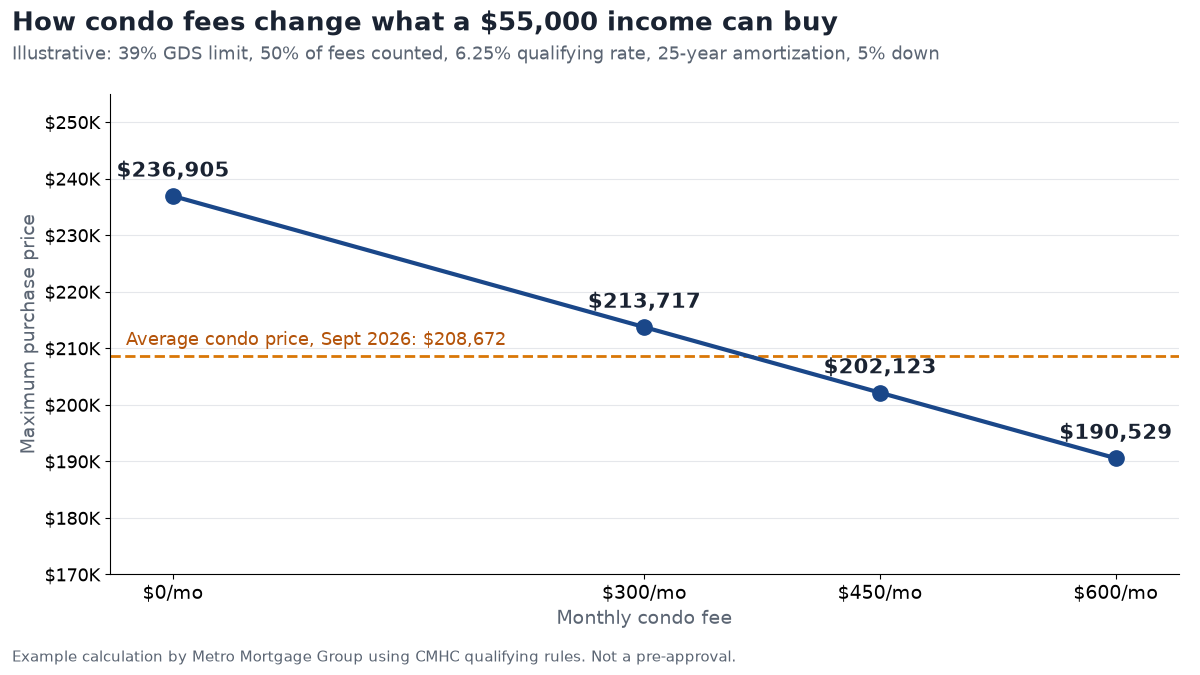
CMHC counts half of your monthly condo fee as a housing cost, alongside principal, interest, property taxes and heating, and caps that total at 39% of gross household income (CMHC). Every dollar of fee therefore eats into the payment you can qualify for. In our example below, each $100 a month cuts borrowing by about $7,600.
That 39% cap is the gross debt service (GDS) ratio. CMHC also caps total debt at 44% of gross household income, and half the condo fee counts in that total debt service (TDS) test as well (CMHC).
You also qualify at a higher rate than you’ll actually pay. CMHC’s qualifying rate is the greater of the contract rate plus 2%, or 5.25%. Our Edmonton mortgage rates page works through payments at example rates.
Our example: a $55,000 household income
This is an illustration, not a rate quote or advice. It applies the GDS test only, with these assumptions:
- $55,000 gross household income and no other debts
- CMHC’s 39% GDS limit, with half the condo fee counted
- $180 a month in property tax, roughly the City of Edmonton’s 2026 total residential rate of 0.0103637 on an assessment near $210,000 (City of Edmonton)
- $75 a month for heat (our estimate)
- A 6.25% qualifying rate (illustrative), 25-year amortization, semi-annual compounding
- 5% down, with CMHC’s 4.00% premium added to the loan
| Monthly condo fee | Maximum mortgage (premium included) | Maximum purchase price |
|---|---|---|
| $0 | $234,062 | $236,905 |
| $300 | $211,152 | $213,717 |
| $450 | $199,697 | $202,123 |
| $600 | $188,242 | $190,529 |
With no condo fee, this buyer tops out near $236,900. With a $600 monthly fee, and nothing else changed, the ceiling falls to about $190,500. That’s below the September 2026 Greater Edmonton Area apartment average of $208,672.
The $7,600 comes from the payment math. Only half the fee counts, so each $100 of fee uses up $50 of monthly payment room. At 6.25% over 25 years, $50 a month carries about $7,637 of mortgage.
Get the exact fee on every unit you’re serious about. Our guide to how much mortgage you can afford covers the rest of the calculation.
Which documents should you request when buying a condo in Edmonton?
In Alberta, a condo corporation must respond to a written document request within 10 days of receiving it, unless its bylaws state otherwise (Government of Alberta). Plan around that window, because you’ll want the documents in hand, and read, before your financing condition ends.
The province’s March 2026 fact sheet on these documents is written for owners, mortgagees (lenders) and prospective purchasers. Talk to your real estate lawyer about what to request, and have them review what comes back.
Estoppel certificate
An estoppel certificate is a signed statement from the condominium corporation that certifies a set list of information. The maximum fee is $200, or $300 if the owner asks for it on a rush basis. Your lawyer can explain what it confirms.
Information statement
A corporation may charge up to $100 to produce an information statement, plus up to $50 if you need it within three days. The items you can ask it to cover include:
- particulars of any legal action served on the corporation, including any amount claimed
- the amount in the capital reserve fund as of the date of your request
- structural deficiencies the corporation knows of in any building on the condominium plan
- loan disclosure statements for current loans
Reserve fund plan, annual report and study report
Alberta condo corporations generally need a reserve fund study every five years (Government of Alberta). The province’s 2026 fact sheet says the study must identify what may need repair or replacement over at least the next 30 years, and a purchaser or mortgagee who asks in writing must receive these within 10 days (Government of Alberta):
- the most recent reserve fund plan
- the most recent annual report on the reserve fund
- a copy of the reserve fund report
Minutes of general meetings
The March 2026 documents fact sheet also lists the approved minutes of all general meetings of the corporation, if available. Read them alongside the reserve fund documents and flag anything unclear for your lawyer.
What’s the catch with the cheapest condos in Edmonton?
A price well below the $208,672 September average raises fair questions, and the documents are where you answer them. An information statement costs up to $100, plus up to $50 for a three-day turnaround, and can cover legal actions, the reserve fund balance, known structural deficiencies and current loans.
A low price on its own tells you little about a building. Work through these questions with your real estate lawyer before your conditions come off:
- What will the fee do to your approval? In our example, a $600 monthly fee cuts a $55,000 earner’s maximum price to about $190,500.
- How healthy is the reserve fund? Compare the balance in the information statement with what the study report says may need repair or replacement.
- Has a special assessment come up? Ask the corporation, and read the approved general meeting minutes with that question in mind.
- Is the corporation facing legal action? The information statement can set out the particulars and any amount claimed.
- Does the corporation know of structural deficiencies? Ask for that disclosure in the information statement.
- Is the corporation carrying loans? Request loan disclosure statements for current loans.
How we can help with buying a condo in Edmonton
Getting pre-approved before you book showings means you’ll know your ceiling before you fall for a unit. Because CMHC counts half of each listing’s condo fee against its 39% limit, the fee moves that ceiling from one listing to the next, so it helps to run real listings through your numbers as you shop.
We offer 24-hour mortgage pre-approval and work with 30+ lenders, including ATB Financial, Servus Credit Union, CMLS and Scotiabank. If you want to see how a particular listing’s fee changes your approval, we can run the numbers with you.
If you’ll be shopping for a few weeks, our guide to rate holds explains how they work. When you’re ready, get in touch with our team.
Frequently Asked Questions
How much do I need to buy a condo in Edmonton?
At the September 2026 Greater Edmonton Area apartment average of $208,672 (REALTORS® Association of Edmonton), CMHC’s 5% minimum works out to $10,434 down (CMHC). CMHC also suggests budgeting 1.5% to 4% of the price for closing costs, such as legal fees.
Do condo fees affect my mortgage approval?
Yes. CMHC counts 50% of condo fees in the gross debt service ratio, which is capped at 39% of gross household income (CMHC). In our example of a $55,000 income, a $600 monthly fee lowers the maximum purchase price from about $236,900 to about $190,500.
What is an estoppel certificate in Alberta?
It’s a signed statement from the condominium corporation certifying a set list of information. Under Alberta’s rules it costs at most $200, or $300 on a rush basis, and the corporation must respond within 10 days of a written request unless its bylaws say otherwise (Government of Alberta). Your real estate lawyer can explain it.
How often does an Alberta condo need a reserve fund study?
Generally every five years (Government of Alberta). The province’s 2026 fact sheet says the study must look at least 30 years ahead, and purchasers and mortgagees can get the latest reserve fund documents within 10 days of a written request (Government of Alberta).
About the author: Daniel De Sousa is a co-owner of Metro Mortgage Group and leads its team of mortgage professionals. Metro has arranged mortgages for Alberta borrowers since 2010 and works with a network of 30+ lenders.
Sources
- REALTORS® Association of Edmonton (via CREA board statistics), Greater Edmonton Area market report, September 2026 (“New inventory is still being added, but sales have slowed for fall”), retrieved 2026-10-26, https://stats.crea.ca/board/edmo/
- CMHC, What are the general requirements to qualify for homeowner mortgage loan insurance?, retrieved 2026-10-26, https://www.cmhc-schl.gc.ca/consumers/home-buying/mortgage-loan-insurance-for-consumers/what-are-the-general-requirements-to-qualify-for-homeowner-mortgage-loan-insurance
- CMHC, Calculating GDS / TDS, retrieved 2026-10-26, https://www.cmhc-schl.gc.ca/professionals/project-funding-and-mortgage-financing/mortgage-loan-insurance/calculating-gds-tds
- CMHC, CMHC Mortgage Loan Insurance cost, retrieved 2026-10-26, https://www.cmhc-schl.gc.ca/consumers/home-buying/mortgage-loan-insurance-for-consumers/cmhc-mortgage-loan-insurance-cost
- Government of Alberta (Service Alberta and Red Tape Reduction), Condominium Documents for Owners, Mortgagees and Prospective Purchasers (March 2026), retrieved 2026-10-26, https://open.alberta.ca/dataset/b1c13245-86dd-41a1-b540-4cc40b58bb04/resource/34ee93cb-2b09-489e-84b3-d123ecd03582/download/sartr-condominium-documents-owners-mortgagees-prospective-purchasers-2026.pdf
- Government of Alberta (Open Government), Reserve fund study providers, plans and reports (publication page), retrieved 2026-10-26, https://open.alberta.ca/publications/reserve-fund-study-providers-plans-and-reports
- Government of Alberta (Service Alberta and Red Tape Reduction), Reserve fund study providers, plans and reports (2026 fact sheet), retrieved 2026-10-26, https://open.alberta.ca/dataset/d809758f-a046-4ec6-96f5-fe623c4b29e1/resource/b07e748e-53fc-46bb-998c-d5af6c34c1a8/download/sartr-reserve-fund-study-providers-plans-reports-2026.pdf
- City of Edmonton, Property Taxes (2026 tax rates table), retrieved 2026-10-26, https://www.edmonton.ca/residential_neighbourhoods/property-taxes