



Buying or Renewing After the Rate Hike: What to Do Now in Alberta

The Bank of Canada’s October 28, 2026 increase hit variable rates right away, while fixed rates moved on their own track. Prime rose a quarter of a percentage point to 4.70% at Canada’s six largest banks (Canadian Mortgage Trends), but the five-year Government of Canada yield, which fixed rates follow, fell in the days after the decision (Bank of Canada).
That changes the math differently depending on whether you’re getting a mortgage or renewing one. Our recap of the decision covers why the Bank moved. This guide covers what to do about it. Advertised rates can change within 24 hours, and some companies buy down the rates they advertise, so this guide uses example rates, 4.75% fixed and 4.25% variable, to show the math. They aren’t quotes or today’s market rates.
Key Takeaways
- Variable moved first. Variable mortgages follow prime, now 4.70% at the big banks. Fixed rates follow bond yields and lender margins, so don’t assume your fixed quote moved with the Bank.
- Buying: the stress test is the higher of 5.25% or your contract rate plus 2%. In our example, each quarter point on that test trims the most a household can qualify for by about 2.3%.
- Renewing: in our example, starting a new term six months early on $400,000 at 2.50% costs about $4,400 in extra interest. Rates would need to be about 4.99% at renewal to earn that back.
- Either way: you can lock in a rate for 60 to 130 days when you get preapproved, depending on the lender (Financial Consumer Agency of Canada).
What actually changed after the rate hike?
Variable rates moved first. Variable mortgages move with prime, and RBC raised its prime rate to 4.70% on October 29, 2026 (RBC), as did the other big banks (Canadian Mortgage Trends).
Fixed rates are a different story. They follow bond yields plus the margin each lender adds, and the five-year Government of Canada yield fell from 3.62% on decision day to 3.46% on November 2 (Bank of Canada). So don’t assume your fixed quote moved with the Bank.
Here are the example rates this guide uses. For a rate based on your own file, ask for a quote.
| Example | Five-year fixed | Five-year variable |
|---|---|---|
| Rate | 4.75% | 4.25% |
| Monthly payment on $400,000 | About $2,270 | About $2,159 |
25-year amortization. Examples to show the math, not quotes or today’s market rates.
What does the rate hike mean if you’re getting a mortgage?
If you’re looking at variable, your payment went up and your qualifying room shrank. If you’re looking at fixed, it depends on your quote. In 2026, banks must test you at the higher of 5.25% or your contract rate plus 2% (Financial Consumer Agency of Canada). At our example rates, that makes the test 6.25% on variable and 6.75% on fixed.
| Household income | Variable, test a quarter point lower (6.00%) | Variable at our example rate (6.25%) | Fixed at our example rate (6.75%) |
|---|---|---|---|
| $90,000 | $379,000 | $370,400 | $354,000 |
| $120,000 | $531,400 | $519,300 | $496,300 |
| $150,000 | $683,800 | $668,200 | $638,600 |
Largest mortgage the test allows in our example: housing costs at 39% of gross income, the federal guideline, with $500 a month for property tax and heat, no other debts and a 25-year amortization. Other debts lower it. It’s a ceiling, not a budget or a pre-approval.
On $120,000 of income, a quarter point on the test is worth about $12,100 of room. In our example, variable leaves about $23,000 more room than fixed.
Fixed or variable on a purchase?
On $400,000 over 25 years, our example variable rate starts at about $2,159 a month and our example fixed rate at about $2,270. If your variable payment moves with prime, it would take two more quarter-point increases to reach the fixed payment.
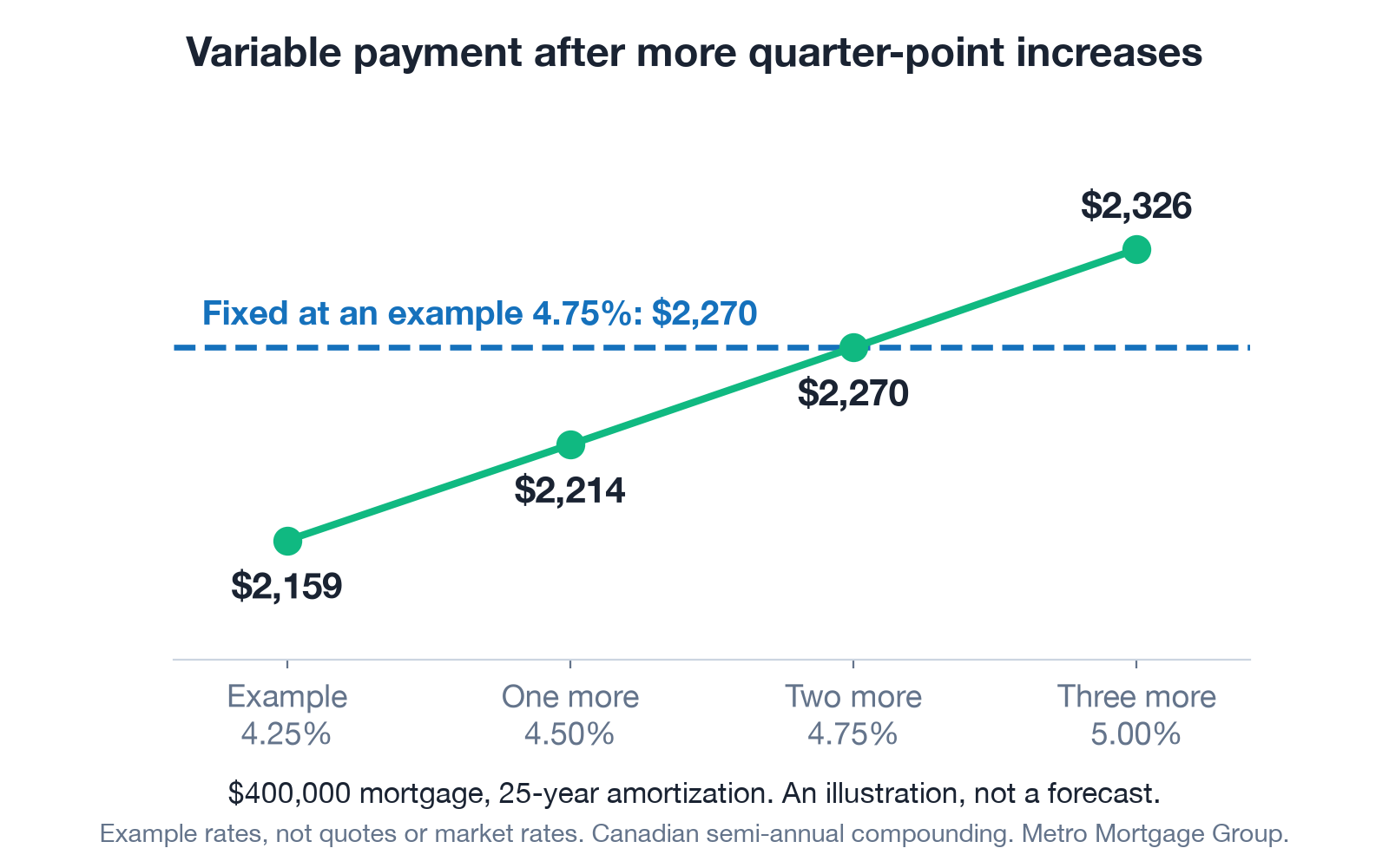
The practical question is whether your budget could handle those steps. Our fixed vs. variable guide goes deeper.
What to do if you’re buying
- Get a rate hold before you shop. Getting preapproved can lock in a rate for 60 to 130 days, depending on the lender. It doesn’t guarantee your approval (Financial Consumer Agency of Canada).
- Ask three questions about the hold. How long is the rate guaranteed? Do you automatically get the lowest rate if rates fall while you’re preapproved? Can the pre-approval be extended?
- Already holding a rate? Check your dates. A hold only helps if you close before it runs out, so line up your closing date against it now.
- First-time buyer? Price out 30 years. Since December 2024, all first-time buyers and all buyers of new builds can get a 30-year amortization on an insured mortgage (Department of Finance), with a 0.20% premium surcharge (CMHC). At an example 4.75% on Greater Edmonton’s $423,100 September benchmark with the minimum down payment and the 4.00% insurance premium (4.20% at 30 years) added to the mortgage, the payment falls from about $2,372 to about $2,173. You’d pay about $70,700 more in total if the rate stayed the same for the full amortization.
Greater Edmonton buyers also have more to choose from. September sales were down 10.3% from a year earlier, while inventory rose 16.7% (REALTORS® Association of Edmonton). Our Edmonton and Calgary rate pages work through payments on a benchmark home at example rates.
What does the rate hike mean if you’re renewing?
It depends mostly on the rate you’re leaving. In its May 2026 Financial Stability Report, before this hike, the Bank of Canada estimated that the last pandemic-era five-year, fixed-payment mortgages, about 12% of all outstanding mortgages, would renew over the following 12 months with payments up about 15% on average. Another 14% or so, variable-payment mortgages and shorter-term, fixed-payment mortgages taken out after rates rose in 2022 and 2023, wouldn’t see their payments change on average (Bank of Canada).
Here’s what our example rates mean at three balances.
| Balance at renewal | Five-year fixed at 4.75% | Five-year variable at 4.25% |
|---|---|---|
| $250,000 | $1,609 | $1,543 |
| $350,000 | $2,253 | $2,160 |
| $450,000 | $2,897 | $2,778 |
Monthly payment with 20 years left on the amortization. These are illustrations at example rates, not quotes.
Should you renew early to beat another hike?
If your rate is well below the rate you’d be offered today, probably not. Take a $400,000 balance with six months left in your term, and suppose you could start a new five-year term at an example 4.75% now instead of waiting.
| Your current rate | Extra interest over those six months | Rate needed at renewal to earn it back |
|---|---|---|
| 1.89% | About $5,600 | About 5.06% |
| 2.50% | About $4,400 | About 4.99% |
| 3.50% | About $2,400 | About 4.88% |
An illustration with 20.5 years left on the amortization, before any penalty or fee. The earn-back compares interest over a five-year term, and the early term would also end six months sooner. Your lender may blend rates instead.
A rate hold closer to your date protects you without giving up your lower rate early. If your current rate is above what you’d be offered today, the math flips. Our guides to renewing early and blend and extend cover both cases.
What to do, based on when you renew
-
More than six months out. Nothing’s urgent. Find out how your mortgage is registered, because a collateral charge can add fees and time if you switch (Financial Consumer Agency of Canada).
-
Four to six months out. Start comparing. The federal consumer agency says to shop a few months before your term ends and not to wait for the renewal letter.
-
About 120 days out. Ask about a rate hold, and get quotes in writing so you can use them.
-
When your renewal statement arrives. A federally regulated lender must send it at least 21 days before your term ends. Negotiate: you may qualify for a lower rate than the one in your letter, and you can tell your lender about other offers.
-
Before you sign. Don’t let it roll over. If you do nothing, your renewal may be automatic. If you’re switching, ask about discharge, registration and appraisal fees, and whether the new lender will cover them.
Shopping is where the money is. Different lenders may have different rates and conditions for similar products (Financial Consumer Agency of Canada). On $350,000 over 20 years, a half-point difference is about $94 a month, or about $8,200 in interest over five years. Our mortgage renewal guide walks through the steps.
Thinking of stretching your amortization to soften the payment? Some borrowers have (Bank of Canada), but the federal consumer agency says to think twice, because the extra interest can reach thousands or tens of thousands of dollars.
Will rates keep rising?
Nobody can promise either way. “There could be a need to increase the policy rate further,” the Bank said on October 28, adding that it agreed to proceed carefully (Bank of Canada). The next decision is December 9, 2026. Plan around what your budget can absorb. Our when-to-lock guide covers the timing.
Frequently Asked Questions
Does the rate hike change my fixed-rate mortgage right now?
No. Your contract runs for its term (Financial Consumer Agency of Canada), so your fixed rate stays put until then. The new rates reach you at renewal. A variable mortgage is different, and our recap shows what a quarter point adds.
Do I have to pass the stress test to renew?
The federal consumer agency lists refinancing and taking out a home equity line of credit as the times an existing borrower must pass it. If you move an uninsured mortgage to another federally regulated lender with no increase to the loan or the amortization, OSFI no longer prescribes the minimum qualifying rate for it, though the new lender still reviews and stresses your application (OSFI).
Is a shorter term cheaper right now?
Not automatically. Three-year and five-year terms are priced separately, so either one can be lower at a given time. Compare the rate and how long you want it for.
How can Metro help you compare your options?
We compare 30+ lenders on your actual numbers. Pre-approval usually comes within 24 hours, and we hold a rate with one lender while we keep watching the market. Call 780-974-1270 or email info@MetroMortgageGroup.ca for a current quote.
About the author: Daniel De Sousa is a co-owner of Metro Mortgage Group and leads its team of mortgage professionals. Metro has arranged mortgages for Alberta borrowers since 2010 and works with a network of 30+ lenders.
Sources
- Bank of Canada, Bank of Canada raises the policy rate by 25 basis points to 2½%, retrieved 2026-11-03, https://www.bankofcanada.ca/2026/10/fad-press-release-2026-10-28/
- Bank of Canada, Canadian bond yields, retrieved 2026-11-03, https://www.bankofcanada.ca/rates/interest-rates/canadian-bonds/
- Bank of Canada, Financial Stability Report 2026: Households, retrieved 2026-11-03, https://www.bankofcanada.ca/publications/financial-stability-report/financial-stability-report-2026/households/
- RBC Royal Bank, RBC Royal Bank announces change to prime rate, retrieved 2026-11-02, https://www.newswire.ca/news-releases/rbc-royal-bank-announces-change-to-prime-rate-837555648.html
- Canadian Mortgage Trends, Big banks raise prime rates to 4.70% following BoC hike, retrieved 2026-11-02, https://www.canadianmortgagetrends.com/mortgage-wire/2026/10/28/big-banks-raise-prime-rates-to-4-70-following-boc-hike/
- Financial Consumer Agency of Canada, Preparing to get a mortgage, retrieved 2026-11-02, https://www.canada.ca/en/financial-consumer-agency/services/mortgages/preparing-mortgage.html
- Financial Consumer Agency of Canada, Getting preapproved for a mortgage, retrieved 2026-11-02, https://www.canada.ca/en/financial-consumer-agency/services/mortgages/preapproval-qualify-mortgage.html
- Financial Consumer Agency of Canada, Renewing your mortgage, retrieved 2026-11-03, https://www.canada.ca/en/financial-consumer-agency/services/mortgages/renew-mortgage.html
- Department of Finance Canada, Government announces mortgage reform details, September 24, 2024, retrieved 2026-11-03, https://www.canada.ca/en/department-finance/news/2024/09/government-announces-mortgage-reform-details-to-ensure-canadians-can-access-lower-monthly-mortgage-payments-by-december-15.html
- CMHC, Premium information for homeowner and small rental loans, retrieved 2026-11-03, https://www.cmhc-schl.gc.ca/professionals/project-funding-and-mortgage-financing/mortgage-loan-insurance/mortgage-loan-insurance-homeownership-programs/premium-information-for-homeowner-and-small-rental-loans
- REALTORS® Association of Edmonton, New inventory is still being added, but sales have slowed for fall, retrieved 2026-11-02, https://realtorsofedmonton.com/statistic/new-inventory-is-still-being-added-but-sales-have-slowed-for-fall/
- Office of the Superintendent of Financial Institutions, OSFI exempts uninsured mortgage straight switches from the prescribed MQR, retrieved 2026-11-02, https://www.osfi-bsif.gc.ca/en/guidance/guidance-library/osfi-exempts-uninsured-mortgage-straight-switches-prescribed-mqr-implements-portfolio-lti-limits